


Joseph Wharton at 200
Looking back at the singular vision that established a renowned school and inspired business education around the world.

“[It is] the duty of every one to perform well and cheerfully his part as a member of the community whose prosperity he thus advances and shares.”
Joseph Wharton, Founder of the Wharton School of Finance and Commerce (in founding document, dated June 22, 1881)
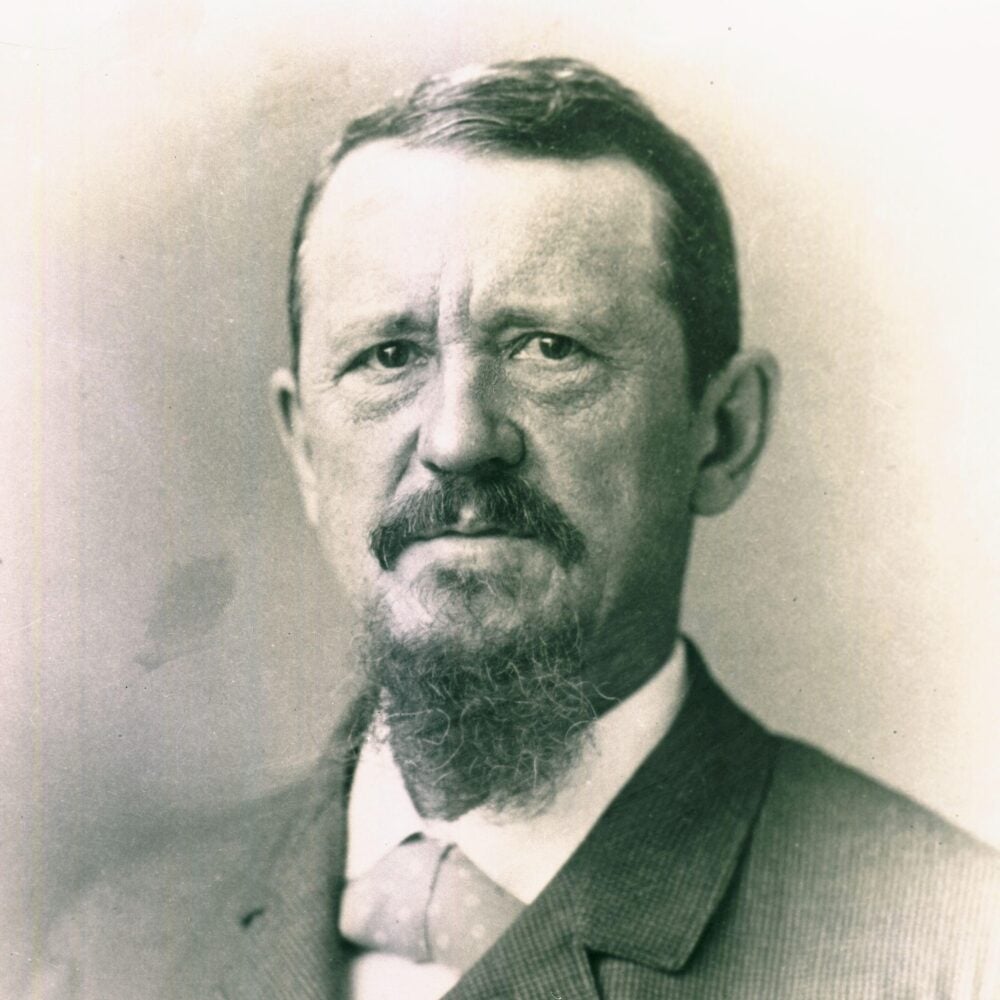
A portrait of industrialist, philanthropist, and founder of the Wharton School Joseph Wharton (circa 1890). (Image Credit: Courtesy of Penn Libraries University Archives)
The Wharton School commemorates the 200th anniversary of the birth of its founder, Joseph Wharton, on March 3, 2026. Wharton was an industrialist, reformer, philanthropist, and founder of the world’s first collegiate business school. He came of age in Philadelphia during the rise of the American Industrial Era, at a time when the city came to be known as the “Workshop of the World.”
Joseph Wharton was born to a prominent Quaker family and, over the course of his life, he helped shape American manufacturing, mining, and metallurgy. However, his most enduring contribution was not in metal or manufacturing — it was an idea: that business education deserves academic rigor, ethical grounding, and public purpose. Two centuries after his birth, the institution bearing his name continues to carry that idea forward.
“Joseph Wharton’s pioneering approach to business education set the tone for the next century and a half of innovation at Wharton,” asserts Wharton School Dean Erika James. “His foresight to educate leaders versed in evidence-based knowledge to drive societal progress remains our ethos. I am inspired every day by our community’s ambition to tackle complex challenges and make a positive impact in the world. It reminds me that Wharton is so much more than a school — it’s an institution that has always, and will always, lead with purpose.”
The following historical timeline traces the life and legacy of the Wharton School’s founder, a visionary whose impact continues to inspire and shape global business education.*
Joseph Wharton Throughout History
1826
A Quaker Foundation
Joseph Wharton is born on March 3rd in Philadelphia to William Wharton and Deborah Fisher Wharton, ministers of the Hicksite Quaker tradition. The family household is a religious one marked by a commitment to discipline, education, and moral responsibility. These Quaker values mold Wharton’s ethical outlook, industrial practices, philanthropy, and lifelong interest in education.
1842-1845
Resilience and the Pursuit of Knowledge
As a teenager struggling with chronic health challenges, Wharton’s family sends him to a farm in Chester County, Pa. to recover. During this period, he immerses himself in the study of agricultural chemistry, languages, and business practice. What begins as convalescence becomes a formative education in scientific thinking and disciplined pursuit of knowledge.
1845-1853
Experimentation and Enterprise
Working under the guidance of his brother Rodman Wharton, Joseph Wharton explores a range of ventures — from managing family estates, exploring white lead manufacturing, and refining cottonseed to dabbling in brickmaking and woolen milling. While not all successful, these experiences collectively sharpen Joseph Wharton’s understanding of industrial operations, chemical production, and financial management.
1853-1863
Zinc and Industrial Leadership
Wharton manages the Pennsylvania and Lehigh Zinc Company, helping it to become the first successful producer of metallic zinc in the United States. This work in mining and metallurgy establishes him as a formidable industrial innovator, and it lays the groundwork for future ventures in the nickel and steel industries.
1863
Nickel Innovation
Wharton acquires the Gap Mining Company nickel mine in Camden, N.J., and establishes the American Nickel Works. In 1875, the company produces the first pure nickel metal in the United States.
1863-1899
Steel Industry and National Impact
Wharton diversifies his industrial portfolio, transforming the Bethlehem Iron Company into the Bethlehem Steel Company. Under his leadership, the Pennsylvania company becomes the largest producer of pig iron in the United States. Wharton helps to pioneer high-strength steel and armor plating for naval warships, maintaining a lead role in the company until selling off his interests in 1899.
1864-1907
Growing Educational Interest
Alongside his mother Deborah Fisher Wharton, Joseph Wharton contributes to the founding of Swarthmore College in Swarthmore, Pa., one of the earliest coeducational institutions in the United States. He later heads the school’s board of managers as president for a quarter century — all the while building momentum for his second major educational venture at the University of Pennsylvania.
1870s-1880s
Conservation and Public Stewardship
Over a period of decades, Wharton acquires vast tracts of land in New Jersey’s Pinelands, eventually forming “Wharton Tract” in excess of 150 square miles. Now known as Wharton State Forest, this represents the nation’s first National Preserve for public use and ecological study.
1881
Establishing the Wharton School
Wharton donates $100,000 (approximately $3 million today) to the University of Pennsylvania to establish the Wharton School of Finance and Commerce, which becomes the world’s first collegiate business school. Joseph Wharton’s vision marks a shift to a different model of learning, from trade-based instruction to academic business education — an approach later adopted around the world.
1909
Long-Term Legacy
Joseph Wharton passes away on January 11th in Philadelphia at the age of 82, after witnessing nearly three decades of growth for the Wharton School. The institution he founded continues to grow in influence and global reach.
1981
Stamp of Approval
To the delight of businesspeople, historians, and philatelists alike, Wharton appears on an 18-cent U.S. Postal Service stamp commemorating the rise of professional management education. It is the centennial anniversary of the founding of the Wharton School.
2026
A Bicentennial Birthday and What Lies Ahead
The Wharton School celebrates Joseph Wharton’s 200th birthday year — in tandem with the United States Semiquincentennial year — while looking ahead to the School’s own 150th anniversary in 2031.


“Joseph Wharton’s pioneering approach to business education set the tone for the next century and a half of innovation at Wharton. His foresight to educate leaders versed in evidence-based knowledge to drive societal progress remains our ethos.”
Wharton School Dean Erika James
Joseph Wharton was more than an efficient business strategist and American industrial capitalist. He was a scientific entrepreneur, innovator, and producer of foundational American metals. He was a philanthropist and leader, committed to promoting financial literacy and responsibility. Above all, he believed that business education could elevate both the marketplace and society as a whole. His lifelong values harnessed the power of visionary education and reform.
Two hundred years after Joseph Wharton’s birth, that vision continues to shape every Wharton School graduate — and the world they seek to change.
*SELECT BIBLIOGRAPHY
Joseph Wharton, 1826-1909: Ironmaster, Innovator, and Educator: A Suite of Paintings and Drawings (David Brewster, Ed., Prospect Park Press, 2012)
Joseph Wharton: Quaker Industrial Pioneer (W. Ross Yates, Lehigh University Press, 1987)
The Pragmatic Imagination: A History of the Wharton School, 1881-1981 (Steven A. Sass, University of Pennsylvania Press, 1982)
“For the Man Who Started Business Education” (in “Stamps”) (Samuel A. Tower, The New York Times, June 21, 1981)
The Wharton School: Its First Fifty Years, 1881-1931 (The Wharton School of the University of Pennsylvania, 1931)
By Brian Kantorek
March 3, 2026